Dog Pug

Hiển thị các bài đăng có nhãn double merle sheltie; blind and deaf dog;. Hiển thị tất cả bài đăng

Teaching Automatic Check Ins to a Deaf Dog

 tháng 9 28, 2018     Deaf Dog Awareness Week, dog training, double merle sheltie; blind and deaf dog;, holistic dog training, Uniquely Paws-Able     No comments   


A very important key to getting and keeping your deaf dog's attention is to teach an Automatic Check-In.  This sounds just like what it means.  

We want to teach the dog to check in with us often and automatically throughout the day. Think of all the times when you want to get your deaf dog's attention but it's looking in another direction or in another room, or is across the yard from you.  These are those times when people want to know how to get their deaf dog's attention.  The times when the dog is not looking at us.

It's important that we have certain signals that ask our dog to pay attention to us in the moment, such as what we discussed yesterday.  These are signals that we can teach to our dogs.  Just the fact that we are teaching those signals will help our dogs to watch us closer, because the dog doesn't want to miss the signal and miss a chance to get or do something fun with us.  

But the dog still needs to be looking in our direction or be close enough that we can give the signal easily, right?  What about those times when it's not?  

What if we could create many opportunities throughout the day when the dog was magically looking at us and close enough to us to see our signals?  Wouldn't that make life so much easier?  

We can teach our dogs to keep an eye on us and to come see what we're doing on a regular basis throughout the day (this is called checking-in with us).  The idea is that the dog will do this on its own without us needing to give a signal (this is the automatic part).  Each time the dog looks at us or comes close to us to check in, we have an opportunity to communicate with a signal cue if we want to. This opens up so many more opportunities for us to be able to communicate clearly and easily with our deaf dog.

Dogs of any age can learn this, and I usually start as soon as a dog enters my home or comes for its first lesson.  Create a situation where the dog will remain near you and where there aren't a lot of distractions.  Believe it or not, the bathroom is a great place to begin!  It's a smaller room, and there aren't usually too many distractions going on.  (Although toilet paper can be a huge distraction to some dogs!)

It's important to remember that the idea of this exercise is not to try to get the dog's attention.  The idea is for the dog to give you its attention on its own.  This can be difficult because it involves patience on the part of the teacher.  

Every time your dog turns toward you, give it one of those wonderful treats!  And smile and act happy that your dog has noticed you.  It won't take long before your dog will be following you around the bathroom, not wanting to look away.  When this happens, reward and then end the lesson.

Try to be as aware as you can even during your regular day to day activities of your dog - there will be times that it looks at you or comes to see what you're doing.  Be ready to reward those times too!  You can have containers of treats in various parts of your house or in your pocket.  

But you can also reward with other rewards your dog will like - petting, smiling, belly rub, toss a toy, etc.  At this point, you will want to continue with your formal bathroom lessons, but also be aware to reward times when your dog checks-in on its own!  Your teaching will go much faster that way!

It will take some practice on your part too - you will need to teach yourself to be aware of your dog paying attention.  Often we get busy and our dog will check in with us, but we may not notice.  As your dog learns to check in, you will also learn to check in and be aware.

You should find that very quickly your dog won't need to be in the bathroom for lessons anymore.  Begin to practice in other places and situations, gradually increasing distractions.  When you increase distractions, you will want to use high value treats in the beginning.  

Keep your dog close to you in the beginning when you are adding distractions.  This may mean using a gate or a leash so your dog can't get to the distractions.  Remember, the idea is not for you to ask your dog to pay attention - the idea is for the dog to decide.  So be patient and be ready as soon as the dog turns toward you, to reward and celebrate!  

You will be able to begin to mix up the rewards you use, like we talked about yesterday.  The more you can show your dog that you like it checking in with you, the better the behavior will become. But you don't always have to use a treat.  

My dogs have been doing check-ins for years, but I will always acknowledge them for checking in to keep the behavior strong.  Sometimes all it takes is a smile and a nod to let them know I noticed, or a scratching behind the ear.  

The day that you want to give your dog a signal cue but it is looking the other way and then, in an instant, it looks back to see what you're doing, you can smile - and then give your dog that cue you wanted to give.  It's so convenient to have a deaf dog that learns to pay attention without you asking for it.  I know that if I just pause a moment, my dog will check in with me, so I can give it a signal.  

Teach the automatic check in - you will thank yourself (and your dog) for it soon! 


Read More
  • Share This:  
  •  Facebook
  •  Twitter
  •  Google+
  •  Stumble
  •  Digg

How Do I Get My Deaf Dog's Attention?

 tháng 9 27, 2018     Deaf Dog Awareness Week, dog training, dog wellness, double merle sheltie; blind and deaf dog;, double merle sheltie; white dog blog, holistic dog training, Uniquely Paws-Able     No comments   


When people ask me how they can get their deaf dog's attention, they often mean how can they get its attention right now in this moment.  Usually this is because the dog is doing something they want it to stop, or they need the dog to come to them. 

There are various ways to get a deaf dog's attention in the moment.  By far, the most foolproof one is to actually go to where the dog is to get its attention.  By going to the dog, we can now position ourselves in a way the dog will easily see us, or we can touch the dog - either is going to alert the dog to the idea that we want its attention.  

I often notice people trying and trying to get their deaf dog (or any dog for that matter) to pay attention without success, and instead of going to the dog, they just continue to try on and on.  Meanwhile the dog is getting into trouble, and sometimes into a dangerous situation.  If what you're doing is not working - it's always best to step in and go to the dog to manage the situation quickly. 

Sometimes we may be in a situation where the dog will be able to feel a vibration through the floor.  Be aware, however, that some dogs will not really pay attention to this unless they've been taught that the vibration has some significance.  Also, surfaces carry and distribute vibrations in various ways.  In my experience, wooden decks carry vibration very well, while harder surfaces such as concrete really aren't that good at conducting vibration.  

Some dogs may respond to the vibration of a loud clap or noise.  Again, this usually works best if the dog is taught what that vibration means ahead of time.  

Flashing a light when the environment is darkened can be a great way to get a deaf dog's attention.  Many of us who live with deaf dogs have learned that flashing the porch light when the dog is in the yard at night is a suitable way to let it know to come back into the house.  Similarly, if this can also work in a darkened room of the house.

Waving an arm in a large arc that takes up a lot of space can get a deaf dog's attention too, if you can catch their eye.

An important part about getting a deaf dog's attention is to take the time to teach the dog that these things mean you'd like it to look at you for more information.  This doesn't have to take very long, and it's not complicated.  In fact, the more of these signals that you teach, the easier it will be in various circumstances to get your dog's attention quickly.  

Let's take the example of teaching a dog to pay attention to a large wave of your arm.  Begin close to your dog and with your dog already paying a bit of attention to you.  At first you need to create an association so your dog understands that an arm waving in the air is a wonderful thing to see!  So having your dog's attention when you start is the best way to create this association.  Have plenty of tasty treats handy. 

Associate the wave with a good thing - the treat!  The sequence is to wave first - make it as big as you can - and then feed a treat.  Make the treats extra special and you will see your dog making this association very quickly!  A large wave - a great treat.  This is the sequence.  Do it many times.  Then take a break and go do something else.  Probably your dog will follow and watch you closely for a bit.  That's normal. 

Do many mini sessions during the day and in different rooms of the house, or in the front yard, or the back yard.  You can even practice on walks - take your treats with you.  Right now, you want there to be a great treat every time you wave your arm so the association your dog is creating will be very strong.

After you've practiced this for several days in different environments, you can begin to throw a random wave into your day here and there.  Make sure you have that tasty treat but hide it for a bit beforehand in a pocket or a container hidden around the house.  When your dog is nearby but is not paying a lot of attention to you, wave that big wave.  When your dog notices, it should quickly pay attention to you - at which point you can reward with the treat and lots of praise or even a game!

Paying attention to you should always be a super fun thing for your dog to do!  Be sure to make it worth your dog's while to pay attention to you when you ask!  

With more practice, you should be able to give the wave signal from farther away or at more random times during the day.  If you have created a strong association by rewarding often with things your dog loves, your dog should be learning to watch for that wave out of the corner of its eye, in the hopes of seeing that you want its attention and getting something great in return!  

You can teach other attention-getting signals with the same process.  Use the signal you want to teach followed by things your dog loves!  Create the association.  Start off close to your dog and make it easy, then gradually start incorporating it into your daily life.  

Once you know the association is strong, you can begin to randomize the rewards you give.  Sometimes play a game, or give some petting if that's something your dog likes, or go for a ride in the car - just make sure it's something your dog really likes.  Getting your dog's attention for things that aren't pleasant will create avoidance instead of alert attention. 

Now you've created easy ways to get your dog's attention so you can call it to come to you, or give it a different cue signal, or just redirect its behavior.

But ... there is one more key ingredient to getting and keeping your deaf dog's attention.  And, we'll talk about that tomorrow!  


Read More
  • Share This:  
  •  Facebook
  •  Twitter
  •  Google+
  •  Stumble
  •  Digg

Bark for Life Photos

 tháng 6 01, 2018     double merle, double merle sheltie; blind and deaf dog;, double merle sheltie; white dog blog, holistic dog training, Invincible Vinny, therapy dog, trick training, White collie     No comments   


It was an honor to take part in the Bark for Life with Vinny this year.  He was invited as an honored guest and we did a demo in which we taught about double merles and showed off some of his amazing tricks!  Vinny tasted his first ice cream cone - which he loved!  And we hung out with our friends from the Humane Society and told everyone about our adorable pets for adoption!  


Photo: Effingham County Bark for Life

Photo: Because of Jadyn Photography


Read More
  • Share This:  
  •  Facebook
  •  Twitter
  •  Google+
  •  Stumble
  •  Digg

Therapy Dog!

 tháng 4 30, 2018     dog wellness, double merle, double merle sheltie; blind and deaf dog;, double merle sheltie; white dog blog, Invincible Vinny, therapy dog, Uniquely Paws-Able     No comments   


Congratulations to Vinny!  He got his official Therapy Dog paperwork and tag just in time - did you know that today is National Therapy Animal Day?  It is!  

A day to celebrate animals of all types that provide love and therapy to others!  I have been blessed to partner with several therapy dogs in my lifetime.  Vinny is my 5th therapy dog partner.  

Not all organizations are open to evaluating dogs that are both blind and deaf.  I was fortunate to work with a local group with Treasure (blind and deaf) and they were open to evaluating her and seeing just what she could do.  She passed with flying colors and was my therapy dog partner for 8 years.  She is now mostly retired and has passed her knowledge along to Vinny.

I'm so excited to begin our therapy dog work together!  
Read More
  • Share This:  
  •  Facebook
  •  Twitter
  •  Google+
  •  Stumble
  •  Digg

Hearing - or Not Hearing

 tháng 4 20, 2018     dog training, dog wellness, double merle sheltie; blind and deaf dog;, holistic dog training, Uniquely Paws-Able, white dog blog     No comments   


I am sick - which is a bummer.  But I've also had a chance to experience first-hand something that I counsel so many people about - dogs losing their hearing, or dogs with partial hearing.

My left ear has been clogged now from this cold for several days.  I am not hearing normally from that side.  While this is annoying for me, I had a revelation yesterday.  And then I started to pay more attention to what I was hearing and not hearing.

Sounds that normally I would not pay attention to, or would discount easily and go on with my day, were startling me.  I couldn't recognize what the sound was or where it was coming from.  It's unsettling to hear something and not know what it is.  

Each time I went to investigate, I found out the sound was one that I hear every day and easily would have known what it was from a distance.  Because I would have recognized the sound, it would have been very easy to go on with my day.  

Dogs that are losing their hearing must go through this same thing.  How unsettling for them.  Of course, on an intellectual level I already knew this was true - but experiencing it for myself allowed me to put an actual emotional experience with it.  

I felt myself startle, hold my breath and try to listen harder to figure out the noise I was hearing.  I felt the compulsion to know and went searching to find out what it was.  I felt the unsettled feeling of hearing unfamiliar sounds.  My dogs do the same, and they may jump up barking and carrying on because they've heard something unusual that they can't identify - something that may be a threat and they should warn us about.

Dogs born with partial hearing won't always be able to recognize or pinpoint where a sound is coming from.  Dogs with ear infections or other conditions that affect their ears may become more fearful or reactive as they deal with things not sounding the same and safe to them.  And dogs losing their hearing too.  We have no way to know exactly what they are hearing at any given point in that process.  


Read More
  • Share This:  
  •  Facebook
  •  Twitter
  •  Google+
  •  Stumble
  •  Digg

Hide Him Away?

 tháng 4 05, 2018     double merle sheltie; blind and deaf dog;, double merle sheltie; white dog blog, holistic dog training, Invincible Vinny, Uniquely Paws-Able     No comments   


Here is my handsome, clever, fun-loving boy Vinny on our recent trip to Purina Farms.  This picture was taken at their Visitor Center and he is smiling, which is his normal state of mind.  You see, on this day, it was Saturday morning and the Visitor Center was full of children!  In fact, we struggled at times to get a picture, as children were running up to him trying to pet him and say hello.  Vinny loves children!  They are just at his nose height and he thinks they smell divine!

If you've followed this blog for very long, you know that I love to travel with and do all sorts of activities with my dogs.  This blog just happens to focus on my dogs that are double merles and are therefore blind and/or deaf.  But I do have other dogs too - dogs that can see and hear and aren't double merles.  I enjoy doing things with them as well.

I am a dog person through and through.  My life does revolve around my dogs much of the time.  And I love all my dogs - even the ones that can't see and hear.  Living with them, those differences fade from the forefront.  I don't focus on what they can't do.  We spend our time figuring out how to do more and more together. 

I realize that to most people we meet out in public, my dog is an oddity.  I mean, it isn't every day that people meet a dog that can't see or hear at all, right?  People think I am some sort of rock star to sacrifice my life to care for this poor dog with such devastating disabilities.  But this is not reality ...

You see, that is only their perception.  I have my own perceptions of the situation, too.  To me, my dog doesn't have any devastating disabilities.  He is funny and smart and capable of doing anything - it just happens that he can't see or hear.  He loves to play.  He likes new adventures.  He has a personality.  I am not a rock star.  I am just a person, just like these other people, who happens to see past the differences to see all those things that a blind and deaf dog has in common with me.  And I have chosen to make him my friend.

Some people say that me teaching Vinny to do fun things and earn dog sports titles is somehow encouraging people to want a blind/deaf dog just like him.  They think that me enjoying my partnership with my dog is encouraging people to breed more dogs like him or to go out seeking a dog just like him.  I guess they think I should hide him away somewhere where no one will see him - to keep him a secret that I'm ashamed of?


Again, I don't do these things with my dog because he's blind and deaf.  I do these things with my dog because he's my dog and we like doing things together!  I like earning ribbons and titles with my dogs - all of them!  I like traveling with my dog and watching him explore and learn about new things.

I hate to think about what would have happened had I hidden away all of my differently-abled dogs!  When I started this blog, there was hardly any useful information out there about working with blind and deaf dogs.  So many were killed.  So many people didn't think they were capable of learning anything at all - not even to be toilet trained! 

Without my brilliant dogs showing the world that they are feeling, thinking and learning dogs, there are many dogs that would not have been given the chance to find great homes.  Today, there are many differently-abled dogs out there having great fun doing activities with their people!

I love my dog just the way he is!  But I would love him just as much if he had been born able to see and hear!  It is not his fault that he was born this way.  He wants to play and learn and explore.  I want these things for him too.  I don't want to hide him away.

Yes, that means we do get a lot of attention.  I use the attention we receive to help share with as many people as I can.  I share about the consequences of breeding two merle patterned dogs together.  I share about the realities of living with a blind and deaf dog - it's not all a piece of cake!  There are challenges.  There are rewards. 

I share with rescues and fosters and shelters how to teach these great dogs and find the best homes for them.  I share to dispel myths.  I share with fellow trainers so there will be more who can help clients with differently-abled dogs across the country and even around the world.

I'm proud of my dogs.  Please don't expect me to hide them away somewhere.  How would you feel if someone expected you to hide your dog away somewhere?  I know you're proud of your dog too.

With anything that brings attention, there comes the risk that someone else wants to recreate it for themselves.  If someone makes a movie about Dalmations and the dogs are so very cute, then so many people want a Dalmation whether it is the right breed for them or not.  If someone makes the world agility team with a pyrenean shepherd and it's super fast, then many people want a pyrenean shepherd.  If people see me working with a blind and deaf Collie, will people want to get themselves a blind and deaf Collie too?

You get the idea.  It's not the fact that my dog is blind and deaf that may make people want to imitate me.  It's like this with anything - that is why we have fads.  Someone thought something was cool and wanted it too.  Education and advocating is the way to stop the double merle epidemic.  Hiding them all away just won't work.

I cannot stop the attention I receive from doing what I love with my dogs.  My wish, though, is to teach compassion and responsible breeding.  And to promote adoption of differently-abled dogs whenever it is the best match for that person.  And always, I promote positive reinforcement training.  This is the message I want people to get when they see me with my dogs.  Don't create more of them - but for the ones that are already here, make their lives as full as possible! 


Read More
  • Share This:  
  •  Facebook
  •  Twitter
  •  Google+
  •  Stumble
  •  Digg

Vinny's Adventures and Brags!

 tháng 2 04, 2018     dog training, double merle sheltie; blind and deaf dog;, holistic dog training, Invincible Vinny, Uniquely Paws-Able, White collie, white dog blog     No comments   


Invincible Vinny recently became the first blind and deaf dog to earn his Novice, Intermediate, and Advanced Trick Dog titles through the AKC!  To celebrate, AKC sent him some lovely medals!  

Before Christmas, Vinny earned his Advanced Trick Dog title through DMWYD.  This allowed him to also get all three titles through AKC.  He also earned his first K9 Freestyle title through Poised for Success.  That's a lot of title letters to add after his name!

If you don't already follow Invincible Vinny on Facebook, go check him out.  We often post his trick and other videos there so you can keep up with what he's doing next!  Click on his logo below to see his page! 
Vinny is currently practicing for his  Expert and Performer Trick Dog titles, his Trick Dog Champion title, and his next Freestyle title!  Keep an eye out for this star!  

If you'd like to meet Vinny in person, please see his FB page for some events he is making appearances at this year.  And, if you'd like to have him at your event, message him!  


Read More
  • Share This:  
  •  Facebook
  •  Twitter
  •  Google+
  •  Stumble
  •  Digg

Christmas Crafts 2017 - Painted Treat Ornaments

 tháng 12 20, 2017     Christmas, double merle sheltie; blind and deaf dog;, holiday, holistic dog training, Uniquely Paws-Able     No comments   

Purchase plastic Christmas ornaments in whichever shape you prefer.  Plastic is always safer than glass when you have pets around the Christmas tree!  And, purchase or make tiny sized dog treats to fit inside the top opening of the ornaments.

Wash the ornaments inside and out with warm soapy water and leave them open (the top pops out) to dry completely before filling them.  

Fill the ornaments with tiny dog treats!  Hint - if you leave a little empty space at the top of the ornament, it will be easier to pour out the treats to feed to your dog!  If you fill it completely to the top, it may be harder to get the treats back out!  


After filling the ornaments, replace the top part back onto the ornament and tie a colored ribbon on to hang it with.  

I used paint pens to draw and write on the outside of the ornaments to make them more festive!  The paint will need time to dry - mine took several hours of sitting out to be completely dry.  


These are quick and easy to make and are absolutely adorable!  Easy to make for all the doggie friends!


Read More
  • Share This:  
  •  Facebook
  •  Twitter
  •  Google+
  •  Stumble
  •  Digg

Presentation at ASSA National

 tháng 4 25, 2017     blind and deaf dog, dog training, dog wellness, double merle, double merle sheltie; blind and deaf dog;, double merle sheltie; blind and deaf dog; white dog blog, holistic dog training     No comments   

Treasure, Vinny and I had a wonderful time visiting Purina Farms and the ASSA National Specialty. There were Shelties everywhere!  Vinny was also happy that there were some other Collies making an appearance here and there as well.  This was our first time to Purina Farms, and we hope to be able to go again.

We were there to do a presentation about double merles.  Topics discussed included:
What causes double merle
What can be done to educate so we can prevent it
How to screen and educate adopters
Tips for foster homes
How to train dogs that may be blind, deaf, or both
Equipment that may be useful
And, the many myths surrounding double merles and blind and/or deaf dogs


Thanks Barbara Edelberg for the photo


Read More
  • Share This:  
  •  Facebook
  •  Twitter
  •  Google+
  •  Stumble
  •  Digg

Treasure's Travels (and Vinny's too!)

 tháng 4 21, 2017     blind and deaf dog, dog training, double merle, double merle sheltie; blind and deaf dog;, double merle sheltie; blind and deaf dog; white dog blog, holistic dog training, White collie     No comments   


My beautiful Treasure and Vinny accompanied me this past weekend on an adventure!  Treasure and I are very accustomed to traveling together, and Vinny has traveled with us a few times during his puppyhood, but he had many firsts during this trip.  I am so very proud of how he responded to all the new experiences!  I wondered how he would do - visiting a museum, going to a large dog show, and staying in a hotel.

Our first challenge was learning to navigate together through the Museum of the Dog - Treasure in her stroller and Vinny learning to walk beside it and keep his toes out from under the wheels!  This was the first time Vinny would be walking with the stroller.  After only a couple times of walking in front of the stroller and tangling his leash, and a few times of his toes getting bumped by stroller wheels, Vinny said, "Piece of cake, Mom!"  He walked like a pro.  

Both dogs were a bit puzzled by the numerous dog statues that smelled a little strange.  I couldn't help but wonder what my other dogs would have thought, since they can see and some of the statues were large and even a little scary looking!  Of course, Treasure and Vinny are both blind and deaf, so they didn't know what the statues looked like, but they spent a lot of time sniffing them and trying to figure out what kind of dogs they were!  


I didn't think about the fact that Vinny had never been on an elevator before until we were about to step onto the one in the museum.  He went into it easy enough, with no hesitation, but as the elevator began to move downward and the floor moved down under his feet, he looked at the floor with a puzzled look.  I was pleased to see that he wasn't very concerned about it - probably due to all the work we do with moving surfaces.  Going up didn't produce the same puzzlement.  He acted just like a pro.  

When we got to the hotel later, there was once more where he pondered the elevator moving downward, but after that, he didn't even seem to notice anymore.  He checked out the hotel room when we arrived, just like he had been doing it all his life.  Very confident, sniffing every corner and all the furniture, finding his water bowl, playing with his toys.  He did take more trips to come check in with me than Treasure did, wanting to make sure I was OK, no doubt.  

And, while Treasure fell quickly asleep next to me, Vinny continued to check on me all throughout the night.   He would sleep for a bit and then come up to poke me with his nose to be sure of where I was.  I guess he didn't want me to be scared in a new place.  That was very thoughtful of him!  


Read More
  • Share This:  
  •  Facebook
  •  Twitter
  •  Google+
  •  Stumble
  •  Digg

Tools to Help With Separation Conditioning

 tháng 1 25, 2017     dog training, double merle, double merle sheltie; blind and deaf dog;, double merle sheltie; blind and deaf dog; white dog blog, holistic dog training, puppy training, TTouch     No comments   

If your dog is already upset by being left alone, think about how you can change the picture for her.  If she is normally left in a crate, can you leave her in a different way?  Perhaps in an ex pen or a gated room?  If she is left in one area of the house, can you leave her in a different area?  Take time to condition her to enjoy and relax in the new area, just as if she was a baby puppy learning for the first time.  Can you avoid leaving your dog alone for a while until you can teach her a different way?  Perhaps taking her to a dog daycare or finding a friend or family member to stay with her while you’re gone? 

Giving your dog a totally different picture and environment can help break the habit of being stressed, but only if you take the time to help her know that it is OK to be alone.  Moving her to a different area or situation will prevent her from reacting to any possible associations she’s created with the current confinement space.

The more stress you can eliminate from your dog’s life in general will also be helpful.  There are several blog posts on this blog about recognizing and lessening stress in your dog’s life.  Dogs, like humans, hold their stress cumulatively, which means while they may be able to handle a little stress just fine, the more stress that just piles up and piles up on them eventually creates a breaking point and that’s when their behavior can really go south. 

There are tools that can help you in conditioning relaxation and low stress separation.  Of course, this list of tools is not complete.  It is meant to give you some options that you may not have considered before.  Not every tool is right for every dog or every situation.  Some dogs may not need any of them, and some may be helped by several. 

Remote treat dispensers – Remote treat dispensers can be set up to reinforce your dog while she is in the confinement area, and can be used to distribute treats when you are not in the area, so can be useful for transitioning to you being gone.  Be aware that if your dog gets very excited by food, this may not be the best option, as you won’t be conditioning calm, relaxed behavior if your dog is starting at the machine anticipating a treat all day.  These dispensers can be a nice tool to get you started though or to reinforce specific behaviors like being quiet in a crate.

Enrichment – Any enrichment activities that you can fit into your dog’s day will help with giving her mental exercise and help her be more likely to be able to relax when you want her to.   Some enrichment may be safe to leave with your dog unsupervised to help give her something to do while you’re gone.  This will depend upon your own individual dog and finding what works for her.  There are many posts on this blog about enrichment toys and games that can be used for any dog, not just blind and deaf ones.

Covered crate/ open crate – Some dogs are more comfortable in a covered or airline type crate with solid sides, and some are more comfortable in an open wire crate.  Yes, even blind dogs seem to have a preference.  Solid sides make for a more cozy feeling and prevent air drafts coming in from all directions which is disturbing to some dogs.  Some dogs can relax better in a solid crate because they feel secure knowing there is only one opening, where the wire crate feels open on all sides and can cause them to feel nervous or vulnerable and unable to completely relax.  Some dogs are not comfortable at all in crates and prefer a totally different solution. 

Chew toys – Any toys or bones that you leave with your dog unsupervised need to be very safe, and you need to have watched your dog with them enough to know they will not be biting chunks off and eating them.  Chew toys can help by giving your dog something to do and to help them relax.  Dogs tend to relax and nap after a good chew.

Bodywork – Bodywork can help your dog learn how to relax, and you can use it with your dog while she is in her confinement area to help her associate being there with relaxing.  Using bodywork at her normal bedtime may also help, as she will associate it with relaxing and then drifting off for a long sleep.  Massage, Tellington TTouch, Healing Touch for Animals, or any number of bodywork modalities can be helpful.  Some of these can be learned from books and videos, and others can easily be learned by taking classes in your area. 

Essential oils – Some essential oils like lavender have long been known for their relaxing effects.  This is not the only oil that may be helpful – consult an experienced practitioner or veterinarian for more information about this.  The best results come from therapeutic grade oils, not ones just made synthetically to smell pretty.  A practitioner can help you choose a quality that is appropriate.  Diffusing the oils in the room where the dog will be can help, especially if she is conditioned to relax with the oil diffusing before being left alone. 

Thundershirt, TTouch wrap – These are great tools for increasing your dog’s feelings of well-being and confidence, and in helping a dog learn to relax.  But they need to be worn when the dog is being supervised.  So, they could be worn if you are practicing separation but you are home and checking on the dog often to make sure she is not tangled or that she is not eating the shirt or wrap!  So, if you are doing cycles of leaving and coming back, this could be helpful. 

Sniffing and nosework games – I love any type of sniffing or searching games as enrichment.  Dogs love to sniff and search.  Giving them games like this to play every day, and especially before you leave them alone for the day can put them in a better frame of mind for relaxing and a long nap! 


Calming music – If your dog can hear, playing calming music can help her to relax, but can also drown out noises from outside which might keep her alert and wondering what’s going on out there.  It is best to condition the music during relaxing times when you are home at first.  Classical music can work well.  Two of my favorites are Through A Dog’s Ear and Healing Touch for Animals CD’s created with relaxation and calming of dogs in mind.  Even my deaf dogs respond to the music’s vibrations and will often lie by the CD player on the floor so they can feel the vibrations.  They also seem to be able to feel it if the CD player is on top of a solid crate.   Be sure to keep any cords out of chewing range and tucked away so the dog can’t pull the CD player down on top of her. 

DAP collar, spray – Dog appeasing pheromone products can also be very useful.  I find the collars (which stay on all the time) or the spray to be most useful.  I have not had much luck with the plug ins, but know people who have.  If the dog is staying in a crate, I would opt for the spray so the collar won’t get caught on any part of the crate.  The spray can be spritzed on the dog’s bedding before you leave or can be sprayed on a cover put over the crate. 

I hope this has given you some new ideas to try.  Put these last several posts together to create a program to help your dog feel more relaxed with staying alone.  If you would like help getting started, find a positive reinforcement trainer in your area to work with to help get you started and set up a plan that you can continue to work on. 


Read More
  • Share This:  
  •  Facebook
  •  Twitter
  •  Google+
  •  Stumble
  •  Digg

Conditioning Separation

 tháng 1 20, 2017     dog training, dog wellness, double merle, double merle sheltie; blind and deaf dog;, holistic dog training, puppy training, white dog blog     No comments   


Here are some ideas to get you started on teaching your puppy to stay alone with as little stress as possible, and to help create a non-stressful association with the confinement area and being left alone.   Use these ideas as a jumping off point to create a schedule that works for you and your puppy. 

Pet sitters or dog walkers, even willing neighbors, can be so helpful when you have a young puppy.  A normal work day is too long for a puppy to be home alone.  It needs a break or two at least throughout the day to potty, walk around outside and sniff, have a game, have some lunch, etc.  If you’re unable to come home at lunch to do this, or to take your puppy to work with you, please consider hiring someone to help you for awhile.

Begin when you bring your new puppy home.  Schedule some vacation time, or at the very least, bring your puppy home when you will have several days to spend with her with no trips out planned.  Decide ahead of time to spend those several days creating as relaxed and happy association with the puppy being alone as you can.  And then be sure to schedule yourself or someone else to come in at least once during the day when you return to work to let the puppy out and spend some time with her.  This could be a neighbor, family member or a hired pet sitter or walker. 

Have your puppy’s confinement area set up from the beginning and leave it accessible to the puppy all day long – if it is a crate, tie the door open so she can go in and out and explore as she wants.  If it is an ex pen or a gated room, leave the area open for puppy to wander in and out of at will.  Leave interesting things in the area that will encourage relaxation and calm, quiet behaviors – a bed, chew bones and even food-stuffed chew toys like Kongs.  If you notice your puppy being wild and crazy in that area, entice her to come out of the area to play.  That area is for relaxing and calm behaviors.

Puppies take lots of naps between play sessions.  When your puppy is just about asleep or is already sleeping, move her to the special area and let her sleep there undisturbed for her nap.  She will begin to learn by association to be relaxed in that area.  Stay nearby and be ready for puppy to wake up.  As soon as she wakes up, before she can realize she is confined and begins to cry, go to her calmly and take her outside to potty. 

Most important is to keep the times when your puppy is confined to very short, successful periods of time at this point.  During times when your puppy is calm and sleepy, you can sit in the confinement area with your puppy – keep things calm though, no wild games and play time.  You can sit and read a book or watch TV and allow her to settle down and sleep on her own.  Then it is a gradual process for you to sit next to the area – on the other side of a gate or pen – and then farther from the area. 

Gradually you can put puppy into the area a little sooner than normal so she has time to play calmly for a bit or chew a bone and she will learn to settle down on her own.  Stay nearby so you can intervene if you see her beginning to get upset.  Maybe just go into the area with her and sit calmly.  Then try stepping out again once she’s almost asleep. 

If you are crate training your puppy for bedtime, bring the crate into your bedroom and put it right next to the bed.  You can dangle an arm over the side of the bed to put your fingers in through the bars of the crate to provide contact to soothe your puppy, gradually withdrawing your hand as she learns to soothe herself to sleep.  Remember that your puppy will need to potty in the middle of the night.  If she makes a fuss and has been sleeping, get her outside quickly.  But don’t make this a time for games or treats or snuggles on the bed.  Keep the trip matter-of-fact, out and back in.  Upon coming back inside, puppy goes back in the crate. 

What always works best for me at this point is to pull my pillows down to the floor and lie right outside the crate door with it open just enough for me to slip my arm inside.  My body blocks the door from opening all the way and puppy coming out, but my arm inside allows the puppy to snuggle up and go back to sleep.  If puppy decides this is a great time to cut its teeth on your arm, just pull your arm out and press it up against the crate door so it is close but protected from puppy teeth.  As your puppy learns the routine, you will need to spend less and less time on the floor or with your arm in the crate to help her settle back down. 

Puppies cue off our breathing, yes even blind and deaf puppies!  So, keep your breathing calm and relaxed while you lie there, and keep your body relaxed and quiet.  This will help her know it is time to go back to sleep. 

It is a gradual process to teach a puppy to be calm and relaxed when left alone and/or confined.  Yes, this is a lot of work to do properly in the beginning.  It is just one of the aspects of having a puppy that requires a lot of commitment on our part in the beginning to set the puppy up for success for the rest of her life.  She is a baby and it is our job to pay close attention and set her up for success. 


Read More
  • Share This:  
  •  Facebook
  •  Twitter
  •  Google+
  •  Stumble
  •  Digg

Calm Behavior During Grooming

 tháng 10 09, 2016     blind and deaf dog; dog, dog training, dog wellness, double merle, double merle sheltie; blind and deaf dog;, double merle sheltie; white dog blog, holistic dog training, puppy training, White collie     No comments   

If you've been following along in our blog, you know that Vinny has always gotten overstimulated by petting and grooming activities.  Trying to groom him, and often just pet him sweetly, results in him turning to mouth my hand and grooming tools.  If I continue, the mouthing gets more intense and he begins to also move his body around more.  If I continue still, he also becomes vocal and then ... well, it's all over.  

He had gotten so much better until about 3 weeks ago.  He's 5 months old now and his behaviors appear to be reverting backwards in a few areas, but they are now more intense than when he was smaller because he is now a much bigger boy!  

Vinny is now well aware of his marker (clicker) signal, and that it is followed by a reinforcer for certain behaviors.  He knows that his behaviors can drive that marker.  

I have been working with him by reinforcing calm behaviors when I touch, pet and groom him.  I started with just touching him - this was a review for him, but I wanted to start in an area that he could be successful.  I touched him calmly and then followed by giving him a treat.  I allowed him to feel the touch first, before the food appeared, and I fed him the food straight ahead of his nose with his nose facing forward and not at my touching hand.  By reinforcing him with his head away from the hand that was touching him, he did not have the opportunity to begin mouthing me, and he will learn to keep his face away from the hand petting or grooming him (eventually).  

After reviewing this a few times, I moved on to stroking or scratching him lightly just for a moment before feeding.  I was still not using a marker signal at this point because I needed both hands - one to touch and one to have that treat ready super quick by his nose.  When I saw that he was making the choice to turn his head forward for the treat when he felt me petting him, I moved on.  

Adding a second stroke or longer scratching with one hand while I continued to feed treats was the next step.  Only for a short period of time at first and then gradually building up to longer periods of time.  At first I fed treats one right after the other quickly.  But it didn't take long to be able to space out those treats more and more and build up the duration of the stroking.  As I can spread the treats out a bit, I can then begin using the marker signal to pinpoint calm behaviors.  

Now I have progressed to stroking with grooming tools.  I can do several strokes at a time with Vinny remaining in place and calm (no mouthing or vocalizing, and sitting or standing still) between marking appropriate behaviors.  If he gets up and walks away, that is ok.  It is his choice.  He will come back if he wants to do more.  If he moves away, that is ok too.  I just stop and wait.  He will come back closer when he's ready.  

I do allow him to turn and investigate a touch with my hand or the grooming tool, and I allow him to sniff the grooming tools before touching him with them so he knows what I'm going to be doing.  After only a few sessions, I am so pleased and already seeing a big change in his behaviors.

This is good because his big-boy Collie coat is starting to come in and will require a lot of grooming in the future.  I am so pleased that I can create choices for Vinny so he can be a willing participant in his grooming and care.  

This video was taken today - I tried to groom him before our training session so maybe I could get a video of his previous behavior for you - but he sat still like a champ waiting for his reinforcers.  And, so, what you see is not the flailing, mouthing and yelling that was his normal grooming behavior.  This is our 3rd session and you can see he is attentively waiting for his marker and reward.  When he moves as if he is uncomfortable, I don't force him.  I wait or move to groom a different spot for a moment.  When I groom his body, which we've worked on more, I can groom longer before reinforcing.  When I work with his ear and his tail or rear of his body, which we have not worked on specifically, I sometimes only swipe a couple times before rewarding.  

This is a session in its entirety.  The only part cut in the middle was when I had to go check on something in the middle.  It is a bit long (8 minutes appx.) but you can see in real time, how often I am reinforcing still and how he is responding.  When you see him startle and move his head around, he is responding to his marker signal and is waiting for the food!  


Read More
  • Share This:  
  •  Facebook
  •  Twitter
  •  Google+
  •  Stumble
  •  Digg

Affecting Change

 tháng 10 07, 2016     dog training, double merle, double merle sheltie; blind and deaf dog;, double merle sheltie; blind and deaf dog; white dog blog, holistic dog training     No comments   

I wrote this post several months ago, and kept it as a draft - why I was not ready to post it yet I don't know. But when I looked back on it, I noticed something very interesting - I had written it on the day that Vinny, my current foster puppy, was born.  I had no idea at the time that two little double merle puppies had been born that day and I would be instrumental in their lives.  And so, due to this coincidence (or not!), I am ready to post this now ...


When there's something we are truly passionate about, it's easy to get carried away and to push hard for others to see our way of thinking.  We may end up getting angry and going after the other person in a way that we hope will intimidate them to change to our perspective.  But I have seen this scenario enough times to know that it rarely, if ever, works that way.  Anyone who has been on the receiving end of such a situation knows that the first reaction is to feel you are being attacked, and then the natural thing to do is to fight back. Very quickly things get out of control with words being slung around that are hurtful and alienating, and neither party actually accomplishes anything except to cement the idea that they are right even further into their mind. 

Those of you who read this blog already know that I am very passionate about educating people about the issues with merle to merle breeding and why it should not be done.  While I love my double merles and wouldn't change them, I could also love them just as much if they could see and hear normally, and no matter what color they were.  My favorite slogan is, "Until there are none, rescue one!"  Until there are no more double merles, I will continue to educate and to rescue.  

Tonight I am sad.  But I am hopeful.  You see, I initiated an online conversation with a breeder who is utilizing a double merle in a breeding program.  Out of surprise and sadness mostly.  Certainly not to attack this person, but more to express my sadness and concern.  Although I didn't initiate contact to place blame or as an attack, I sort of expected to get a nasty, defensive answer in return, as is often the result of such communications.  Instead I was pleasantly surprised that this breeder and I, with very different views, were able to have a lengthy conversation.  

Our views about our dogs were very similar.  We both love our dogs and enjoy participating in dog sports with them.  We discussed new rule changes in competition.  We discussed the good that this breeder is doing with the current dogs that he/she is working with - training, showing, therapy work.  

Our views about breeding were different.  Our views about breeding were discussed, but calmly, with no word slinging or accusations.  We both heard the other's opinions and perspectives.  Did we end up agreeing with each other on these?  No, but we both felt heard.  And neither of us felt attacked or defensive. 

This is the place where understanding and change can begin to occur.  We cannot think or consider or make decisions when we are attacking or being attacked.  We can't hear another's viewpoint and try to understand their perspective.  Without understanding, how can we affect change?  

It upsets me when people are nasty to each other in the name of change. How can we change if we don't know there is another way?  How can we change if we don't see another way that we feel might be right? When we are educating, it's important to model for people that there is a different way.  We cannot ever make someone else change.  That desire to change has to come from within themselves.  But we can model for them, and we can talk to them about different possibilities.

Remember, though, that each of us starts from wherever we are.  Whatever that person's perspective is, that is where they are. That is what they feel is right, and we all will defend what we feel is right.  As we show people that there are other ways of seeing things and other ways of doing things, they will realize that now there are choices.  Will they choose to change to one of those other options?  Maybe.  Or maybe not.  That is out of our control.  

If the other options we offer them are confrontational or embarrassing, will they be likely to choose them? Probably not.  If the options we offer them to think about are gentle and understanding and forgiving, they will be more likely to go away thinking about them, and more likely to choose them when they decide to make a change.  

Please be kind when you educate.  Remember that you once didn't know these things either.  You had to learn and make a choice too.  Listen to the other person's perspective and remember that is where they are right now and what they feel is right.  Try to understand why they feel that way.  If you can relate something you are trying to teach to something they already can relate to, it will be an easier jump for them to understand and think about. 

Change is not easy, and it does not happen all in one large, all or nothing swoop.  Change comes in stages. Trying to get all at once change is not going to end well.  Allowing change to happen as perspectives change and choices are made, can lead to lasting change, a new person out there educating in line with your perspective now, and possibly a new friend.  Be forgiving of mistakes or back sliding.  Remember this is a process.  It's hard to change our old habits and ways of thinking.  
Read More
  • Share This:  
  •  Facebook
  •  Twitter
  •  Google+
  •  Stumble
  •  Digg

Just Sitting There

 tháng 8 14, 2016     dog training, double merle sheltie; blind and deaf dog;, double merle sheltie; blind and deaf dog; white dog blog, holistic dog training, puppy training, White collie     No comments   

"Oh wow.  I guess I thought he would just be sitting there, doing nothing, a lot of the time."  This is how many people perceive what a blind and deaf dog's day must be like.  Sitting alone in their darkness, nothing to see, nothing to hear, nothing to do, just waiting for me to move them around or feed them.  Otherwise, just sitting there.  Is it any wonder if people have this perception that they question what quality of life my dogs can have?


However, a perception of how things are is not necessarily the reality of how it actually is.  Looking out over a calm pond, our perception is one of stillness and quiet. But what is going on underneath the surface?  Are there fish, toads and turtles swimming and playing and eating?  Are they communicating with each other in their own language that we do not notice?  There is a lot going on in pond culture under the surface of what we see - our perception.  Each being has its own reality of a situation based on its own perception.  The fish will perceive the pond culture in a different reality than the toad, than the turtle, than a human.  

If we only look at the surface, we see a very limited view of what the reality may be.  When we can look below the surface and open our minds to what another's perception may be, a whole new world of possibilities is opened up to us. 

Below the surface of a dog just sitting alone in darkness and silence, what is lurking for us to discover?  In experiencing life from my blind and deaf dogs' perspectives, I know their lives are rich with movement and information at every moment.  It fascinates me - the world they live in, as I can only imagine it.  I'm sure my imagination does not do it justice.

An air current to me may feel like a draft or a welcome breeze, or even an irritant if it blows my papers to the floor.  An air current to my dogs carries a wealth of information.  Someone may have passed by and in a certain direction and at a certain speed.  A door or window opened somewhere in the house and may signal someone arriving or leaving.  The air conditioner or fan may have come on or turned off.  Someone may be calling to wake them up or get their attention.   

Changes in air pressure and how the air moves may signal a piece of furniture or a tree is near and they should slow down or curve away.  And along with these changes in air current or pressure, also come a multitude of smells.  Each thing that we notice with our eyes must have a different smell to a dog.  Think of how many items they come in contact with in a day.  And smells traveling on the air, inside and outside - quite a buffet to behold!  Each being in the home has its own distinct smell.  I believe there are unique smells to different emotions and moods as well.  So many things they may not be able to see with their eyes, but their nose knows!  

A vibration to me may mean a large truck is going by outside.  But think about every noise you hear in a day - some we learn to tune out because they don't concern us, some we have come to learn are very important to us.  What do the noises you hear every day signal to you?  

Each of those noises has a vibration - that is how we hear it and recognize it.  Dogs can notice those vibrations too, even if they can't hear them in the same sense as most of us can.  They most certainly learn to tune out the many that don't have significance to them.  Very quickly, however, they learn the ones that do have significance in their daily lives!  (This is what often causes us to second guess whether a dog that we know is deaf just heard that noise it appeared to respond to!  It was responding to the vibration it has learned is significant.)


Have you ever played the party game where you had to stick your hand into a small hole in a box and figure out what item was inside just by touching it?  It's often harder than it appears to be, because we do rely so much on our sight in our daily lives that we are not consciously aware of how each item feels that we interact with.  Blind and deaf dogs rely a lot on their sense of touch.  Not just for when they touch us or we touch them, but in everything they do.  

It's possible for them to easily map out environments that they use every day.  Even outside, in a yard that appears to us to just be grass, the dogs can tell where in the yard they are.  They map out little dips in the yard, or small slopes, and various smells so they know exactly where they are.  They use surface changes such as mulch, dirt, gravel, brick, and grass, to create their map.  They enjoy the softness of a dog bed or blanket, or the cool firmness of a tile floor.  They know which piece of furniture they are brushing past.  

And these things just brush the surface of what our dogs are aware of.  There is so much to discover beneath the surface of our perception.  

It's easy to form our own judgments about others or about circumstances based on our own perception. That's normal.  It's how we interact with our world.  It takes a bit more effort to open our minds to learning about someone else's perception.  But imagine the possibilities of what you can learn?  

Our perception of what a blind and deaf dog might experience may lead us to put limits on what they can and will accomplish.  If we think they will just sit there, how much of a chance will we give them to do otherwise? Don't let your perception of another create limits in your thinking - or in their potential.  


Read More
  • Share This:  
  •  Facebook
  •  Twitter
  •  Google+
  •  Stumble
  •  Digg

Vinny's Rule of Twelve

 tháng 7 22, 2016     dog training, double merle sheltie; blind and deaf dog;, double merle sheltie; blind and deaf dog; white dog blog, holistic dog training, puppy training, White collie     No comments   

Have you heard of the Puppy's Rule of Twelve, by Margaret Hughes?  It is an adaptation of Pat Schaap's Rule of 7's.  It is a checklist of categories, and within each category, the idea is to expose your puppy to 12 different things in each category by the time he's 12 weeks old.

Vinny is 12 weeks old now.  Let's see how I did exposing him to the various categories so far.  Of course, this doesn't end once you complete the list.  Puppies need to be exposed to many different things for their entire puppyhood, and then on into adulthood.


Vinny's Rule of Twelve

12 different surfaces:  grass, gravel, dirt, carpet, tile, linoleum, wet grass, mud, puddles, uneven surfaces, rubber matting, wading pool, plastic tarp, foam cushion, dog bed, ball pit, metal grate, plastic, metal - 19

12 different objects:  cardboard, wood, balls, tug toys, rubber, feathers, plastic bottle, stuffed toys, metal bowls, squeaky toys, bones, wire crate, plastic crate - 13

12 different locations:  office, car rides, play yards, back yard, walks, front of office, gym of office, cat room, basement, steps, side yard, driveway, vet's office - 13

12 new people:  LOTS of people, children, men, women, at office, at home, in yard on walks - many more than 12!

12 different noises:  thunder, fireworks, vacuum, squawky bird, clapping, barking, phone ringing, washing machine, dishwasher, traffic, motorcycles, dryer - 12 even though he doesn't hear noises, he does respond to vibrations from some

12 fast moving objects:  dogs running, cats, cars and vehicles, hard to say - he can't see them moving.

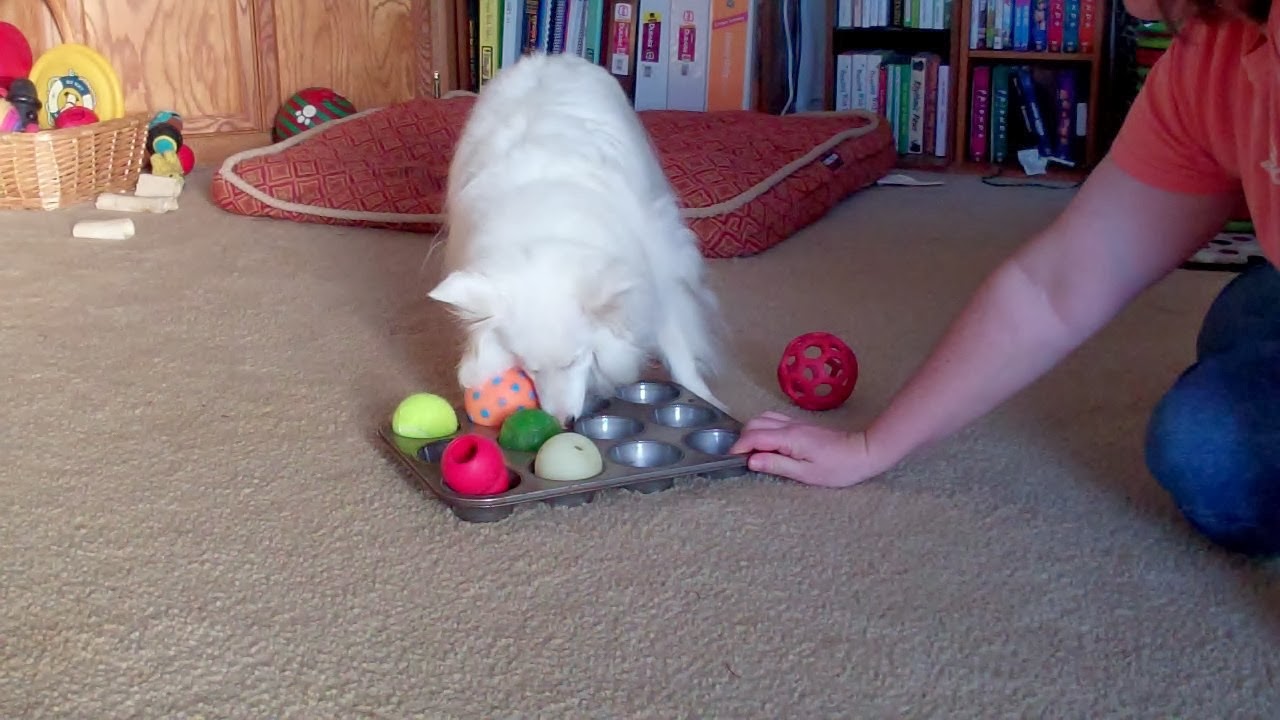
12 different challenges:  obstacle courses, tunnel, ball pit, TTouch star, food puzzle toys - wobbler, food ball, food saucer, muffin tin, steps up and down, uneven surfaces, full flight of stairs - 12

12 handling experiences/week: on his back in my lap, on back in arms, on back on floor, carried under arm, carried with another puppy, grooming, ears, mouth, nail clipping, tail, check eyes, cuddle time, lifted up and down - 13

12 different eating containers:  metal bowl, food ball, muffin tin, kong, ball pit, scattered on floor, hand, kong wobbler, food saucer, ceramic bowl, plastic bowl, elevated bowl -12

12 different eating locations: yard, pen, office, crate, in the rain, different crates - 6

12 different dogs/puppies:  Brinks, Vegas, Owen, Nike, Treasure, Elsa, Daphne, Silva, and kittens! - 12

12 different times left alone/week: many in pen, crate, car even for short periods of time - many more than 12

12 collar and leash experiences new areas:  walks, yard, office, all over - many more than 12

Thanks Cameron for the great pics!


Read More
  • Share This:  
  •  Facebook
  •  Twitter
  •  Google+
  •  Stumble
  •  Digg

Third Week - Puppy Update

 tháng 7 09, 2016     dog training, double merle sheltie; blind and deaf dog;, double merle sheltie; blind and deaf dog; white dog blog, holistic dog training, White collie, white dog blog     No comments   

Pups have turned 10 weeks old this past week!  They are settling into the routine and starting to sleep through the night.  They know their way by scent from the door to the potty area and to the door again when they are done.  They are doing the few steps up and down on their way in and out to the yard.  Our car trips to and from work are now quiet and calm with puppies in their individual crates.  Things are getting a bit easier.  I know what to expect, they know what to expect.


Lots more fun stuff happening this past week for the puppies!

Food bowl games are continuing - not at every meal, just now and then, petting while they eat, looking in an ear while they eat, sticking my hand in the bowl to hand feed a few pieces, moving the bowl slightly while they eat.  I am watching for any signs of stress - hunkering down lower over the bowl, tensing up, stopping eating, eating faster.  But I am doing these things infrequently and very briefly and their reaction is neutral.  I do believe a dog has the right to eat in peace and not be bothered, but I also know that things happen and what the puppies learn now will carry over for their lifetime.  So, I take some time to do food bowl games now while they are young.

Long lead walks to run and explore new areas,smells and surfaces.  Just letting puppies sniff and explore, pick up a stick or a feather they find, I take along a couple toys and encourage some play with me in new places.  I may stop and sit on the ground and just let them explore so they have me to come back to as their security.  Of course these are puppy safe places - watch out for hot surfaces in the summer, and places where lots of other dogs don't frequent.

Puppies are starting to ask to go outside and potty if they need to go at a time that is not on their usual schedule. This is VERY nice!

Puppies did muffin tin eating and food ball eating of their meals - put meals in an empty muffin tin for them to experiment with, and also in food ball toys.  Vinny is very confident in his techniques, picking up and tossing the muffin tin, pouncing on the ball; while Elsa can be more easily frustrated and will tend to give up and walk away.  I help her and make hers easier so she can be successful at this point to help her learn problem solving skills and confidence.  I have no concerns about her as she is normally the more active outgoing one. Just want to make sure she is having good experiences and learning to be successful.

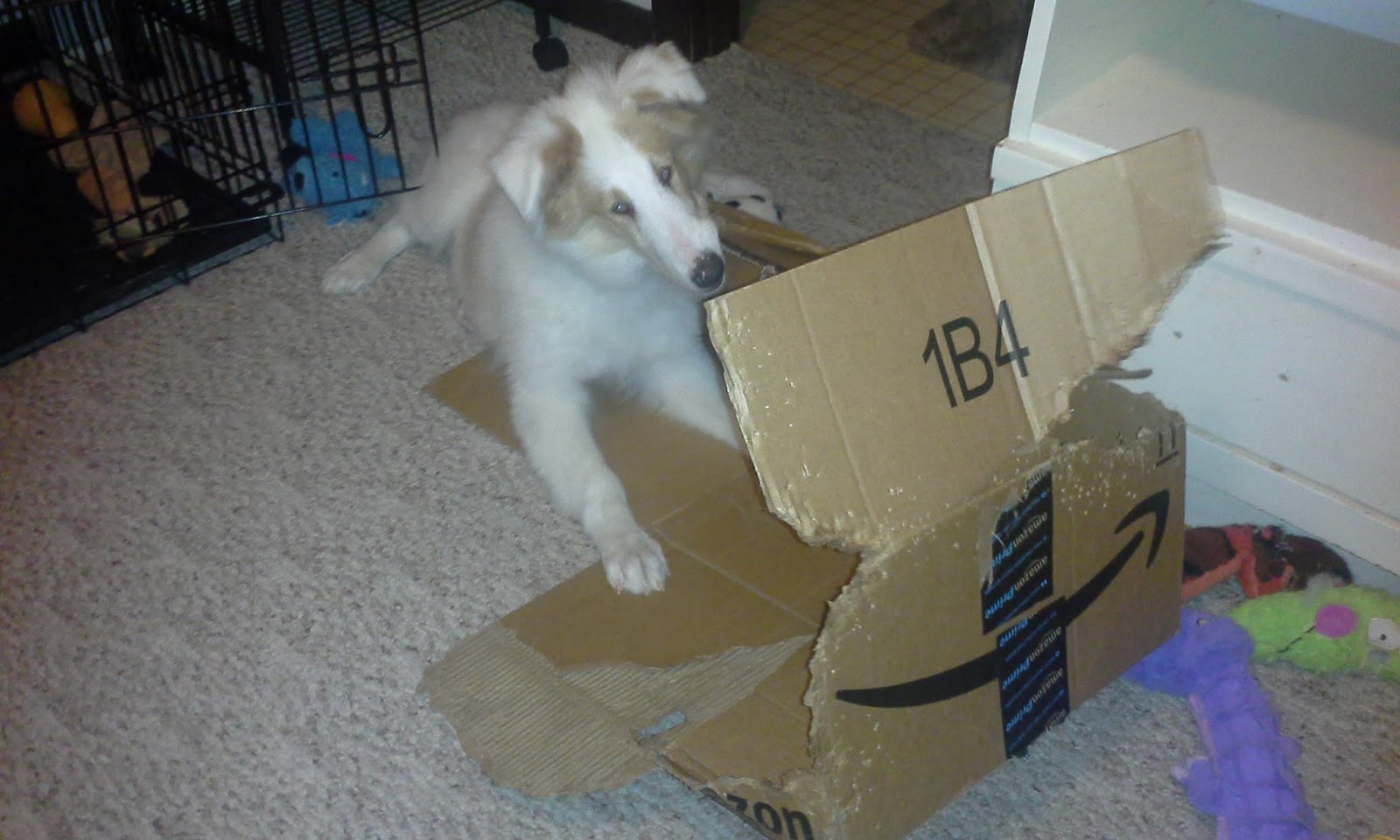
Oh, the empty cardboard box I gave them at the office has been great fun this past week and a half.  It doubles as a toybox that they can pull the toys out of, and a chew toy, as well as a wrestle partner.  They toss it around and dig inside it and roll around with it.  Just the other day, I filled it with new toys.  They had kept the same toys in their office pen for the past two weeks, so I gave them all new toys and they had a blast pulling all the new toys out of the box over and over again.

The puppies' ears are trying to decide whether to stand or tip or flop this week.  Vinny spent most of this week with one ear tipped or straight up, and the other one still floppy.  Elsa's are pretty much both tipped all the time now, although sometimes one will go straight up.


More grooming!  I'm brushing them more thoroughly now - brushing the hair the wrong way to fluff them up, focusing on around the ears, ruff, and back legs where there will be LOTS of Collie hair soon.  And introduced other grooming tools that I used just for a few swipes on their body to help them get used to the different feel - the undercoat rake and the comb.  Worked toward nail clipping with lots of foot handling and managed to cut a nail or two.  Here's a hint:  try to cut puppy nails when they are sleeping!  But if you teach them to love their crates too well, like I did, it is hard to do because they will go find their crates to sleep in. And, it's hard to cut puppy nails while they are in their crate sleeping.  Also did mouth and gum handling to get them used to tooth brushing, looking in their ears, etc.

Elsa and Vinny learned that they enjoy popcorn!  And they learned how sitting like angelic puppies gets them more popcorn than leaping up to pull the whole bowl down.  They also learned about taking turns with the other dogs.

The puppies learned about wearing different types of clothes this week.  Jackets and skirts and shirts - oh my!  Dressing up puppies can be fun for special events and taking pictures - IF the puppy is not bothered and stressed by it.  Elsa and Vinny took it all in stride and were walking around and having fun in their outfits. Dressing puppies in clothes helps them get used to feeling new sensations on their body parts, having their bodies handled and manipulated, and can help them be more accepting of new equipment later on, like harnesses, vests, gentle leaders, etc.


We had a make-shift puppy class this past week.  The puppies got to have their own little class with Nike, a border collie/pitbull puppy of about the same age.  There was no group playtime, as Elsa was a bit worried when Nike tried to jump up on her, but we let them meet and gave them treats to hunt for side by side to let them see that they could be near another puppy and nothing bad would happen.  They each got to go through an obstacle course at the office - new place, new equipment.  Lots of fun!  It's important not to have an agenda when doing a puppy obstacle course.  Let the puppy explore and take the obstacles in the order they want to.  No forcing, just fun and however much they want to do.  It's the puppy's choice.

Two of my adult dogs are really just starting to play with the puppies in a nice way.  This is important for the puppies, as they learn the rules of being a dog, playing, bite inhibition, etc.  They have been learning already when it is ok or not ok to take a toy or a bone the other dogs are chewing on.  There have been a couple times when puppies yelped at being reprimanded by the adults.  I am always supervising them when they are together.  When adults need some quiet time away from puppies, it's important that I provide that.  When puppies get too far out of hand, as they do, I make sure I step in and keep the peace and create space.  It's nice to see them starting to have some real nice playtimes together now.

Elsa will be having a big week this next week, as she is leaving us for her new forever home!  I am so excited for her and her new family, but Vinny and I will miss her.  And I think the other dogs will miss her a bit too.

And, as usual ... a sleeping puppy, is a good puppy.  Vinny has the most unusual sleeping positions!


Read More
  • Share This:  
  •  Facebook
  •  Twitter
  •  Google+
  •  Stumble
  •  Digg
Bài đăng cũ hơn Trang chủ

Popular Posts

  • May 31, 2019
    White Dog had a touch of pride in her voice when she observed, "You know Zsofia embodies the mastery of the best of both worlds. She wa...
  • Book Review: Maxi 's Secrets (deaf puppy, middle school, boy, blind friend, bullying)
    Maxi’s Secrets (Or, What You Can Learn From a Dog) , by Lynn Plourde (Nancy Paulsen Books, 2016, 263 pages, $18.99, grades 4-6) A Sleep...
  • Movie Review: The Adventures of Pepper and Paula (trick dog, horse, cowgirl)
    The Adventures of Pepper and Paula (Vertical Studio, Rated PG, 2015, 90 minutes, $9.97) Remember co-hits? If you are old enough, when ...
  • Some thoughts on The Palms - to sell or not to sell
    I've been thinking a lot about The Palms lately. At this point I'm pretty settled in my new house. It's furnished, warm and comf...
  • May 27, 2019
    White Dog pointedly looked at the clock and then at me; in case I did not get the hint she lined everypup into formation and tapped my leg. ...
  • Book Review: Buddy (dog, Katrina, New Orleans)
    Buddy, by M.H. Herlong (Puffin Books, 2012, 304 pages, $7.99 Kindle, ages 9 and up) “How Far Will a Boy go for a Dog He Loves?” (And the que...
  • Lake Havasu - Part 1 - Our Camp
    Okay, we're back, finally!  I have lots to post about and tons of photos.  When Katie and I left Quartzsite, we headed to Lake Havasu to...
  • Movie Review: A Fish Called Wanda (heist, comedy, London, Yorkies, Jamie Lee Curtis)
    A Fish Called Wanda (MGM, 108 minutes, rated R, 1988 – with Kevin Kline, John Cleese, and Jamie Lee Curtis) Question : Why is DogEvals writ...
  • Goodbye to Elephant Butte State Park
    Here's a photo of our site at South Monticello, where I got all the photos of the lizards.  It was getting really hot, and even though w...
  • May 29, 2019
    White Dog cautioned me to not over-react. "Opal is the one who gets along with everyone. I agree she cannot be allowed to intimidate li...

Bài đăng nổi bật

May 31, 2019

White Dog had a touch of pride in her voice when she observed, "You know Zsofia embodies the mastery of the best of both worlds. She wa...

  • Trang chủ

Tìm kiếm Blog này

Được tạo bởi Blogger.

Copyright © Dog Pug | Powered by Blogger
Design by Hardeep Asrani | Blogger Theme by NewBloggerThemes.com | Distributed By Gooyaabi Templates