Dog Pug

Hiển thị các bài đăng có nhãn TTouch. Hiển thị tất cả bài đăng

Over the Moon!

 tháng 6 29, 2018     blind and deaf dog, dog training, double merle, double merle sheltie; blind and deaf dog; white dog blog, holistic dog training, Invincible Vinny, therapy dog, TTouch, Uniquely Paws-Able, White collie     No comments   


I am over-the-moon proud of my boy Vinny this month!  He and I were away from home for three weeks this month, visiting new places, doing new things, and he took it all in stride.  We had a blast!  It was, of course, so hard to leave the other dogs for that long.  Both Vinny and I missed them so much!  And this was the first long trip that I did not bring Treasure on since she came to live with me 8 years ago.  It was hard to leave her behind.  It is hard for my heart to accept that she is retired now and would rather stay closer to home. 


We stayed at two different hotels and a friend's home while we traveled, so there were many new environments for Vinny to adjust to.  With each new space, he threw himself into exploring.  It is fascinating to watch him mapping out a new space.  He walks the same path many times, and then from different directions and he expands upon that path each time, adding a bit more to the map each time he makes a pass through.  He bumps into some things, but then quickly remembers where they are.  He learns a map of the outside too - from each new door to the elevator, to the door, to the potty area outside, or up and down steps, and he learns the map back to his door at the hotel.  


I was honored to assist once again at a TTouch training with Linda Tellington-Jones.  This was Vinny's first time.  He had fun meeting new friends, moving through the Playground of Higher Learning, and even doing an interview!  You can see his resting space in the background of the picture.  


Elements of the Playground of Higher Learning, such as the labyrinth above, are meant to help a dog learn to move in balance, starting and stopping mindfully.  Moving through the Playground with its person gives both of them a focus, and can change behavior drastically and permanently by allowing both to experience new awareness.  


When we weren't in class, Vinny and I enjoyed getting to know my roommate's new puppy Star.  What a cutie!  The two dogs had way too much fun together, while Rose and I always seemed exhausted trying to keep them occupied and exercised while on the road away from home!  


And, of course, all the excitement makes for sweet dreams!  I'm so very proud of the partner Vinny has become in such a short time already.  Treasure certainly taught him everything she knows and prepared him so well to step into his role as ambassador, educator, and friend.  I couldn't wish for anything more!  I do think we are both happy to be home for a little while, though!  


Read More
  • Share This:  
  •  Facebook
  •  Twitter
  •  Google+
  •  Stumble
  •  Digg

Tools to Help With Separation Conditioning

 tháng 1 25, 2017     dog training, double merle, double merle sheltie; blind and deaf dog;, double merle sheltie; blind and deaf dog; white dog blog, holistic dog training, puppy training, TTouch     No comments   

If your dog is already upset by being left alone, think about how you can change the picture for her.  If she is normally left in a crate, can you leave her in a different way?  Perhaps in an ex pen or a gated room?  If she is left in one area of the house, can you leave her in a different area?  Take time to condition her to enjoy and relax in the new area, just as if she was a baby puppy learning for the first time.  Can you avoid leaving your dog alone for a while until you can teach her a different way?  Perhaps taking her to a dog daycare or finding a friend or family member to stay with her while you’re gone? 

Giving your dog a totally different picture and environment can help break the habit of being stressed, but only if you take the time to help her know that it is OK to be alone.  Moving her to a different area or situation will prevent her from reacting to any possible associations she’s created with the current confinement space.

The more stress you can eliminate from your dog’s life in general will also be helpful.  There are several blog posts on this blog about recognizing and lessening stress in your dog’s life.  Dogs, like humans, hold their stress cumulatively, which means while they may be able to handle a little stress just fine, the more stress that just piles up and piles up on them eventually creates a breaking point and that’s when their behavior can really go south. 

There are tools that can help you in conditioning relaxation and low stress separation.  Of course, this list of tools is not complete.  It is meant to give you some options that you may not have considered before.  Not every tool is right for every dog or every situation.  Some dogs may not need any of them, and some may be helped by several. 

Remote treat dispensers – Remote treat dispensers can be set up to reinforce your dog while she is in the confinement area, and can be used to distribute treats when you are not in the area, so can be useful for transitioning to you being gone.  Be aware that if your dog gets very excited by food, this may not be the best option, as you won’t be conditioning calm, relaxed behavior if your dog is starting at the machine anticipating a treat all day.  These dispensers can be a nice tool to get you started though or to reinforce specific behaviors like being quiet in a crate.

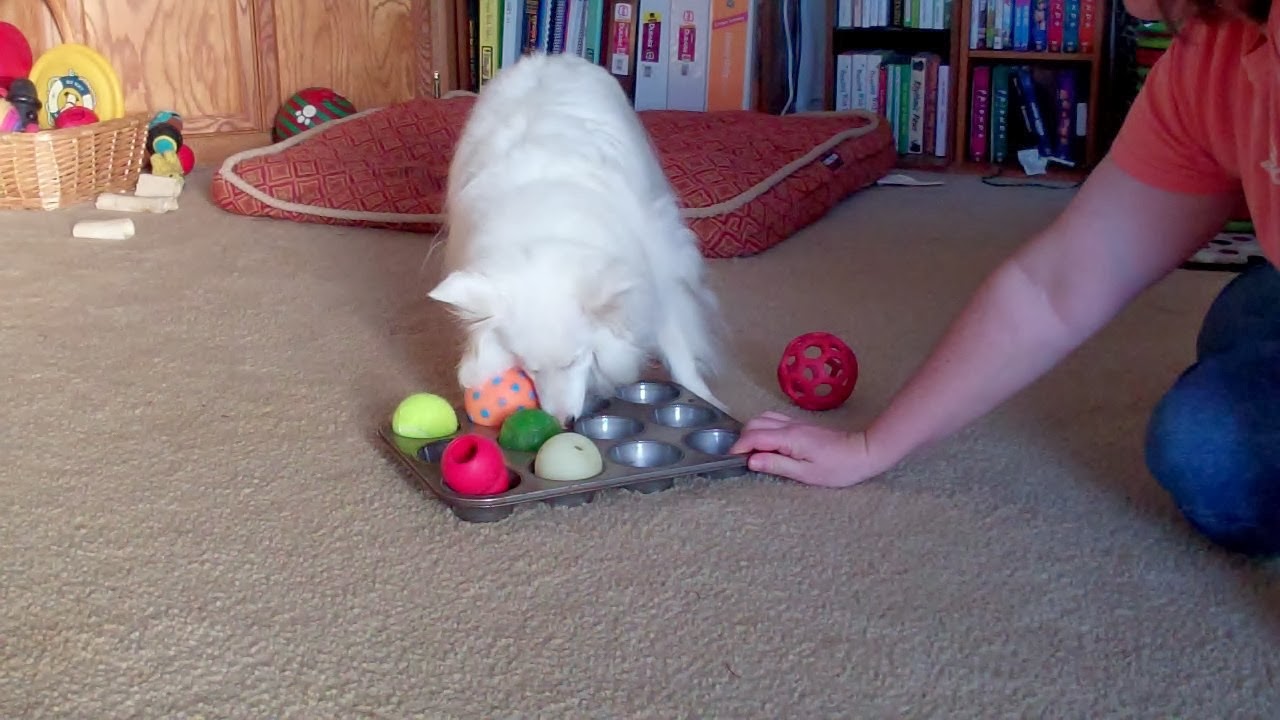
Enrichment – Any enrichment activities that you can fit into your dog’s day will help with giving her mental exercise and help her be more likely to be able to relax when you want her to.   Some enrichment may be safe to leave with your dog unsupervised to help give her something to do while you’re gone.  This will depend upon your own individual dog and finding what works for her.  There are many posts on this blog about enrichment toys and games that can be used for any dog, not just blind and deaf ones.

Covered crate/ open crate – Some dogs are more comfortable in a covered or airline type crate with solid sides, and some are more comfortable in an open wire crate.  Yes, even blind dogs seem to have a preference.  Solid sides make for a more cozy feeling and prevent air drafts coming in from all directions which is disturbing to some dogs.  Some dogs can relax better in a solid crate because they feel secure knowing there is only one opening, where the wire crate feels open on all sides and can cause them to feel nervous or vulnerable and unable to completely relax.  Some dogs are not comfortable at all in crates and prefer a totally different solution. 

Chew toys – Any toys or bones that you leave with your dog unsupervised need to be very safe, and you need to have watched your dog with them enough to know they will not be biting chunks off and eating them.  Chew toys can help by giving your dog something to do and to help them relax.  Dogs tend to relax and nap after a good chew.

Bodywork – Bodywork can help your dog learn how to relax, and you can use it with your dog while she is in her confinement area to help her associate being there with relaxing.  Using bodywork at her normal bedtime may also help, as she will associate it with relaxing and then drifting off for a long sleep.  Massage, Tellington TTouch, Healing Touch for Animals, or any number of bodywork modalities can be helpful.  Some of these can be learned from books and videos, and others can easily be learned by taking classes in your area. 

Essential oils – Some essential oils like lavender have long been known for their relaxing effects.  This is not the only oil that may be helpful – consult an experienced practitioner or veterinarian for more information about this.  The best results come from therapeutic grade oils, not ones just made synthetically to smell pretty.  A practitioner can help you choose a quality that is appropriate.  Diffusing the oils in the room where the dog will be can help, especially if she is conditioned to relax with the oil diffusing before being left alone. 

Thundershirt, TTouch wrap – These are great tools for increasing your dog’s feelings of well-being and confidence, and in helping a dog learn to relax.  But they need to be worn when the dog is being supervised.  So, they could be worn if you are practicing separation but you are home and checking on the dog often to make sure she is not tangled or that she is not eating the shirt or wrap!  So, if you are doing cycles of leaving and coming back, this could be helpful. 

Sniffing and nosework games – I love any type of sniffing or searching games as enrichment.  Dogs love to sniff and search.  Giving them games like this to play every day, and especially before you leave them alone for the day can put them in a better frame of mind for relaxing and a long nap! 


Calming music – If your dog can hear, playing calming music can help her to relax, but can also drown out noises from outside which might keep her alert and wondering what’s going on out there.  It is best to condition the music during relaxing times when you are home at first.  Classical music can work well.  Two of my favorites are Through A Dog’s Ear and Healing Touch for Animals CD’s created with relaxation and calming of dogs in mind.  Even my deaf dogs respond to the music’s vibrations and will often lie by the CD player on the floor so they can feel the vibrations.  They also seem to be able to feel it if the CD player is on top of a solid crate.   Be sure to keep any cords out of chewing range and tucked away so the dog can’t pull the CD player down on top of her. 

DAP collar, spray – Dog appeasing pheromone products can also be very useful.  I find the collars (which stay on all the time) or the spray to be most useful.  I have not had much luck with the plug ins, but know people who have.  If the dog is staying in a crate, I would opt for the spray so the collar won’t get caught on any part of the crate.  The spray can be spritzed on the dog’s bedding before you leave or can be sprayed on a cover put over the crate. 

I hope this has given you some new ideas to try.  Put these last several posts together to create a program to help your dog feel more relaxed with staying alone.  If you would like help getting started, find a positive reinforcement trainer in your area to work with to help get you started and set up a plan that you can continue to work on. 


Read More
  • Share This:  
  •  Facebook
  •  Twitter
  •  Google+
  •  Stumble
  •  Digg

Having All The Answers

 tháng 1 15, 2017     blind and deaf dog, blind and deaf dog; dog, dog training, dog wellness, double merle, double merle sheltie; blind and deaf dog; white dog blog, holistic dog training, puppy training, TTouch     No comments   


My last blog post got a lot of attention and comments, which is good.  That means it accomplished its purpose, which was to get your attention and get you started thinking.  Some comments focused on crate training, and while this concept certainly carries over to teaching a puppy to be comfortable in a crate, it is not exclusive to it.  My post was focused on teaching a puppy to accept separation, in whatever form that might be – behind a gate, in a puppy pen or room, in a crate, or just home roaming the house alone. 

My book Through A Dark Silence goes into how I start crate training for blind and deaf puppies (and other puppies as well). 

Some comments focused on why I didn’t give all the answers in my post.  While I have other posts planned to help offer suggestions, I wanted to first address the general idea and way of thinking.  The purpose of my post was not to give all the answers of how to do something.  Each individual situation and puppy is different.  Techniques and ideas are meant to be adjusted to meet each individual’s needs.  So, no matter what ideas and techniques I write about in my blog, they are not the only way or the only answer for each and every dog.  But those ideas can be adjusted to meet any dog’s needs.

Dog training is not about having all the answers.  Many of us have been teaching dogs (and other animals) for a long time.  We can never have all the answers.  There are always new possibilities to discover, ponder and try.  A wise person once told me – there are many answers to the same question.  But the problem is that we usually stop looking for the other answers when we find one that works.  That limits our learning and traps us in our box.  If we think that our answers are the only ones that are right and can work for a certain situation, we aren’t seeing the whole picture of many possibilities. 
 
If we remain open to learning and exploring new ideas, we can create a much better life for our dogs.  As we learn better ways, we can do better.  Just because an idea is not discovered yet, doesn’t mean it’s not an amazing one! 


Read More
  • Share This:  
  •  Facebook
  •  Twitter
  •  Google+
  •  Stumble
  •  Digg

Just Let Him Cry It Out?

 tháng 1 12, 2017     blind and deaf dog, dog training, dog wellness, double merle, double merle sheltie; blind and deaf dog; white dog blog, holistic dog training, puppy training, TTouch, White collie, white sheltie     No comments   

“Don’t go back to him if he cries.  No matter what you do, you must ignore him if he is barking or crying.  You will spoil him.  Don’t reward his crying.  Just let him cry it out.  He will eventually stop.” 

Have you ever heard this advice?  It seems to be pretty popular advice to give someone with a new puppy. 

Trainers may argue that going back to a crying puppy and giving it attention will reinforce the crying.  While there might be some truth in that statement, I don’t think much thought is normally given to the emotional cause of the crying in the first place, nor to the physiological changes that are happening to a puppy’s body and brain while he is crying. 

Yes, a puppy left to cry it out will eventually be quiet, but is that the best thing for the puppy?  Can letting the puppy cry it out lead to problems with anxiety down the road? Is there a better way?

I'd like to propose a different perspective about teaching a puppy to stay by itself.

Let’s talk about getting a new puppy.  Let's think about his first day leaving his mother and littermates, and that safe puppy pen.  Everything he had known up until this day had been comfortable and safe for him.  He was never alone.  He always had the comfort of others around him.  Taking him away from that safety and security is a major life change for him.  He is stressed and looking for his mom and littermates, and the sense of safety he had known.  Very quickly that sense of safety begins to transfer to the person who is caring for him.  

Is it really necessary for a puppy to learn that very first day how to be alone?  When he already feels terribly alone and wants to cling to the new person in his life so he feels safe?

Vinny feeling very safe in his confinement area.  

Staying alone and learning self confidence should be a gradual process.  Puppies who cry are distressed. They don't cry unless they have a reason to cry.  They aren't crying to keep you up at night.  They aren't crying to annoy you or to interrupt your favorite TV show.  They are scared and alone and they feel vulnerable.  They are calling out for someone to care for them and comfort them, and to help them feel safe.

Puppy brains are always learning.  Do we want our puppy's brain to learn and develop from a place of fear or panic (fight or flight), or from a place of trust and safety?  

I hear often about people who let their puppy cry and howl for an hour (or more) until it begins to quiet down.  Each minute that goes by increases that puppy's stress, anxiety and fear.  I have to wonder if letting a puppy cry it out and become more and more upset until it is exhausted may contribute to separation anxiety behaviors later in life?  It is something to ponder. 

I want to teach my puppies to have the capacity to self calm, so they are able to settle down on their own. To a puppy, being left alone must be a scary feeling.  He is unable to take care of himself, and the group of others he’s always been with has helped to keep him safe.  He may feel vulnerable.  He may become hypervigilant, watching everything to see if it is a threat.  

Puppies very quickly form emotional associations with the situations around them. Spending so much time learning that being alone is scary and stressful can't be good for staying by himself later on. These are not feelings we really want our puppy to associate with being left alone at home or with being in a confined space, are they?
It is a process to teach a dog to calm itself.  It is not something you can just throw at him all at once and expect him to get used to and understand that all is well.  Expecting a puppy to just cope with it and get used to it is very stressful for him.  Puppy is calling to you to help him and you don’t come.  Does this build trust in your new relationship?  Puppy doesn’t understand why the rules have suddenly changed. 

Perhaps this is how it's always been done - letting him cry it out.  Or perhaps it worked for a puppy we had a long time ago, so we are sure it is the best way to do it.  Or maybe you know someone with a dog and it worked for them, so you're sure it will work for you and your puppy.  But don't we owe it to our puppies to consider them as individuals?  To do all we can to build their trust and their confidence that we understand what they're communicating to us?  Sometimes we do need to think outside of our box ... 


Read More
  • Share This:  
  •  Facebook
  •  Twitter
  •  Google+
  •  Stumble
  •  Digg

Teaching Eye Drops

 tháng 12 18, 2016     blind and deaf dog; dog, dog training, dog wellness, double merle, double merle sheltie; blind and deaf dog; white dog blog, holistic dog training, puppy training, TTouch, White collie, white sheltie     No comments   

Many dogs with vision impairments will at some point in their lives require daily eye drops or medications. Treasure gets eye drops daily to keep her comfortable and to keep her eyes moist.  She has learned that they are part of her routine and accepts them with no complaints.

If' you've been following this blog, you know that my work with Vinny to accept handling and grooming has been extensive.  I've been very careful to teach him that he can be a part of the process of his care, which he started out not liking at all, and that he always has the option to say no and walk away.  Most dogs don't do well with humans holding them in place while forcibly doing things to their bodies.  By giving Vinny the option to stay and cooperate with me or to leave, he controls the session and how we progress.  This means that he remains within his comfort threshold.  It also means that I don't get into "dog trainer mode" and try to push him too fast when we are making progress.  It is truly a mutual decision whether to continue or not.

I was amazed at how quickly the process of teaching Vinny about eye drops progressed.  A total of 6 short teaching sessions and he allowed me to put drops into his eyes.  It will take many repetitions and some back stepping in our process to make sure he can commit to a daily process.  But that is OK.  We all need to take steps backwards sometimes to practice the previous steps that we are fully comfortable with, as we begin to stretch our comfort zone to do new things that may not be as comfortable.  

Luckily Vinny is not in a position where he needs to have daily drops.  I am simply teaching him this so that he is prepared should that day ever come.  We are using natural tears drops, which are not medicated in any way, and were recommended by the veterinarian as being safe to use for my dogs' eyes. This means it is safe for me to teach and practice with Vinny, as the drops won't have any adverse effect.

Here are the basic steps I used to teach Vinny to cooperate with getting eye drops.  I have only shown you a snippet of each training session to show the behaviors in the order I taught them.  This is definitely a more lengthy process than is shown in the video, but it will give you some ideas and a place to start.  If you are having trouble, find a positive reinforcement dog trainer in your area that is comfortable teaching husbandry behaviors to help get you started.  And, stay tuned to this blog into the new year!  We will have many more educational opportunities to offer you with a brand new project we are starting!  

Watch the video here ... 


Read More
  • Share This:  
  •  Facebook
  •  Twitter
  •  Google+
  •  Stumble
  •  Digg

Treasure and TTouch

 tháng 5 29, 2015     double merle sheltie; blind and deaf dog; white dog blog, holistic dog training, sheltie, TTouch, white dog blog, white sheltie     No comments   

Treasure accompanied me again on a cross-country trip to our Tellington TTouch training in MD.  She is such a great traveler, even though the trip is about 13 hours long and we drive straight through.  She has a crate to travel in, with water and food puzzle toys as well as an antler to chew on, and she's happy as can be!  

Our friend Maggie made Treasure a lovely name tag to display on her pen, so everyone would remember her name!  Hard to imagine that anyone would forget Treasure, I know, but with so many great people and dogs in the class (and even one cat!) to learn names for, the name tags came in very handy. And they are SO pretty as well!  Thanks Maggie!  


Our friends Rose and Mickey (pictured) shared a hotel room with us and made the place feel like home.  Treasure remembered Mickey by smell right away and followed him around until he found the perfect place for them both to rest for awhile.  Treasure liked having an actual kitchen in our room, and lying on the cool kitchen floor!  Mickey made sure we kept the air conditioning nice and cool!  


 Tellington TTouch is an amazing way of relating to and helping animals with a strong emphasis on respect and appreciation for the animal as a perfect being.  There is a whole philosophy to learn and embody when taking TTouch classes, along with a large toolbox of different touches and techniques.  Each touch is named after an animal and has a specific way to support the body, mind, emotions and spirit of the animal.  Tools include ways to use equipment to communicate more clearly and gently with the animal.  The playground for higher learning can be changed in many ways to assist with balance and focus, as well as confidence.  Wraps are a special tool used to bring a sense of confidence, calming, and/or a better sense of body awareness to assist with balance and well-being.  Here Treasure models a figure 8 wrap (photo by Linda Tellington-Jones).  


I'm looking forward to getting my official certification as a Tellington TTouch Practitioner 1 in September!  This has been a journey of growth and learning and meeting so many wonderful friends who have become family!  Here's a special picture of me and Treasure with Linda Tellington-Jones at the training in May.  Linda is such an amazingly intuitive woman, who is gracious enough to share with each of us and the animals what she has learned over so many years of experience.  Thank you Linda!  


If you'd like to learn more about Tellington TTouch, find a TTouch practitioner near you, or learn more about how you can attend a training, please visit www.ttouch.com.  You'll be glad you did!  


Read More
  • Share This:  
  •  Facebook
  •  Twitter
  •  Google+
  •  Stumble
  •  Digg
Bài đăng cũ hơn Trang chủ

Popular Posts

  • May 31, 2019
    White Dog had a touch of pride in her voice when she observed, "You know Zsofia embodies the mastery of the best of both worlds. She wa...
  • Book Review: Maxi 's Secrets (deaf puppy, middle school, boy, blind friend, bullying)
    Maxi’s Secrets (Or, What You Can Learn From a Dog) , by Lynn Plourde (Nancy Paulsen Books, 2016, 263 pages, $18.99, grades 4-6) A Sleep...
  • Some thoughts on The Palms - to sell or not to sell
    I've been thinking a lot about The Palms lately. At this point I'm pretty settled in my new house. It's furnished, warm and comf...
  • Movie Review: The Adventures of Pepper and Paula (trick dog, horse, cowgirl)
    The Adventures of Pepper and Paula (Vertical Studio, Rated PG, 2015, 90 minutes, $9.97) Remember co-hits? If you are old enough, when ...
  • May 27, 2019
    White Dog pointedly looked at the clock and then at me; in case I did not get the hint she lined everypup into formation and tapped my leg. ...
  • Book Review: Buddy (dog, Katrina, New Orleans)
    Buddy, by M.H. Herlong (Puffin Books, 2012, 304 pages, $7.99 Kindle, ages 9 and up) “How Far Will a Boy go for a Dog He Loves?” (And the que...
  • Lake Havasu - Part 1 - Our Camp
    Okay, we're back, finally!  I have lots to post about and tons of photos.  When Katie and I left Quartzsite, we headed to Lake Havasu to...
  • Movie Review: A Fish Called Wanda (heist, comedy, London, Yorkies, Jamie Lee Curtis)
    A Fish Called Wanda (MGM, 108 minutes, rated R, 1988 – with Kevin Kline, John Cleese, and Jamie Lee Curtis) Question : Why is DogEvals writ...
  • Goodbye to Elephant Butte State Park
    Here's a photo of our site at South Monticello, where I got all the photos of the lizards.  It was getting really hot, and even though w...
  • May 29, 2019
    White Dog cautioned me to not over-react. "Opal is the one who gets along with everyone. I agree she cannot be allowed to intimidate li...

Bài đăng nổi bật

May 31, 2019

White Dog had a touch of pride in her voice when she observed, "You know Zsofia embodies the mastery of the best of both worlds. She wa...

  • Trang chủ

Tìm kiếm Blog này

Được tạo bởi Blogger.

Copyright © Dog Pug | Powered by Blogger
Design by Hardeep Asrani | Blogger Theme by NewBloggerThemes.com | Distributed By Gooyaabi Templates